Danny's Story

Danny Smith leaned on a four-prong cane and took a step forward. His wife and daughters watched with tears in their eyes, overcome with emotion at a sight they weren’t sure would happen again.
Weeks earlier, Danny, a 66-year old submarine systems matter expert from southern Georgia, was still regularly working 12-hour shifts seven days a week. Sought after due to his expertise, specifically for the engine room, he enjoyed working on vessels and his quiet life at home with his wife, Bonnie, and their large family of kids and grandkids.
That all changed one evening when Bonnie noticed a change in Danny’s sleeping pattern. After going to bed early, Bonnie heard Danny tossing and turning upstairs.
“Normally he can sleep through anything, so I knew something was wrong,” Bonnie said.
Finding Danny in bed, Bonnie asked what was wrong. Danny complained of a light being in his eye, which made little sense to Bonnie in the darkened room. She left to let Danny get back to sleep, but knew something was wrong.
“I’m positive the Holy Spirit told me to turn around and go back up the steps,” Bonnie said. “And I’m so glad I did.”
Still restless in bed, Danny told Bonnie he needed to get up, but his legs wouldn’t work. Bonnie thought he could be having a stroke and asked him to speak again. His speech was incoherent; Bonnie immediately called 911.
Paramedics rushed Danny to University of Florida Health Jacksonville. Doctors confirmed an ischemic stroke, caused by a blood clot near his brain stem, and admitted him to intensive care. Danny received a tPA shot, which helped dissolve the clot over the next few hours. Doctors told Bonnie that if she hadn’t gone back upstairs, Danny would’ve died in his sleep. After five days, Danny stabilized but couldn’t walk or manage basic daily tasks.
Danny’s family discussed the next step in his rehabilitation journey and received a visit from a UF Health Rehabilitation Hospital – North liaison at the ideal time.
“A very kind and articulate young lady came to speak with us and told us about the hospital,” Bonnie said. “We knew the Lord sent her. She was the perfect spokesperson.”
They learned about what the hospital offered and decided that is where Danny would go.
Upon admission, Danny met his physician-led team of therapists and nurses, underwent a full assessment and shared his goals, which helped to build a rehabilitation plan. There were several areas to address including right arm and leg weakness, poor balance, cognitive challenges and difficulty with swallowing and speaking.
The hard work began immediately in physical therapy. In order to tackle Danny’s coordination deficits, therapists challenged him through hundreds of repetitions of fundamental movement patterns, such as stepping forward to an appropriate target. The high-intensity workload enabled his brain to make connections and re-learn how to take steps correctly.
With his coordination improving and movements becoming smoother, Danny transitioned to using body-weight support systems on a treadmill. A harness system allowed him to add more of his body weight as he grew stronger while ensuring safety in a controlled environment.
Danny also practiced using stairs. Upon returning home, he told his team he wanted to sleep in his own bed, but that would require climbing stairs to the second floor. Therapists helped Danny use the railing to adjust himself on the steps, as well as overemphasizing picking up his feet to build strength and ensure he cleared the previous step.
Danny made significant strength gains. He progressed from a rolling walker to a quad (four-pronged) cane, which helped with stability. In time, he was able to walk short distances without a device.
“To see him in a state where he was unable to get up and then see him walking was amazing,” Bonnie said. “It was the first sign I knew he was going to be OK.”
Danny’s hard-working attitude was also evident in occupational therapy as he performed exercises to strengthen his right side. Arm raises and shoulder taps improved his control, strength and awareness as he aimed to complete the goal of caring for himself. Danny also worked on hand and fine motor skills by squeezing a stress ball. In addition to strengthening his right side, the activities increased his standing tolerance, balance and both cognitive and motor skills.
Simultaneously, speech therapists worked on communication and swallowing with Danny. He took two different tests to assess how well he could swallow, including the Fiberoptic Endoscopic Evaluation of Swallowing (FEES) test. Once therapists determined his ability to swallow, they guided Danny through exercises to strengthen his muscles used for swallowing and speech. The exercises reengaged the muscles that lift the larynx to further improve his ability to swallow.
Danny also practiced word repetition and short phrases to build his communication and cognitive skills. By discharge, Danny’s speech had become clear, his thinking less foggy and he could converse with his family.
Danny’s family played an important role during his recovery. Not only were his family members encouraging, they were woven into his therapy. Participating in the hospital’s Care Partner Program, his family learned various therapeutic tasks and activities to work on at home with Danny. Bonnie was a constant by his side. She played games with him, shared meals and prayed for his recovery. Her encouragement kept her husband motivated during long therapy sessions.
His daughters also played a crucial role in Danny’s recovery, joining him for dinner every night in the common room. Once able, his daughters even brought a cribbage board along and made Danny start playing the game again.
As Danny accomplished his goals, he reflected on his rehabilitation journey.
“I feel accomplished and proud of myself,” Danny said. “I’m thankful to my team.”
After nearly two weeks at UF Health Rehabilitation Hospital - North, Danny was ready to go home. He achieved everything he set out to accomplish. He could use the bathroom without assistance and spoke with more clarity. The therapists’ ability to push Danny and treat his family with respect amazed Bonnie.
“All the therapists have been very impactful in the recovery process,” Bonnie said. “We cannot say enough about how wonderful the entire staff has been. Without the positive atmosphere, we cannot imagine what his recovery would have been.”
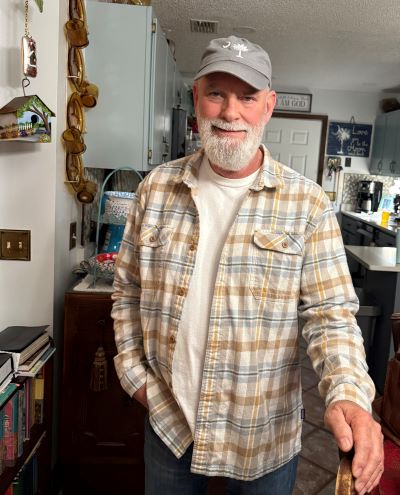
Following his return home, Danny continued outpatient therapy and walks at a local gym twice a week to build strength and mobility. His rehabilitation also set in motion the next chapter for his family, as he decided to retire from his submarine repairman job. Determined to walk into work on his own and sign his papers, Danny did so just four months after being discharged and said goodbye to his colleagues.